Couples usually start looking for a budgeting app at the same moment something small turns into a pattern. One person keeps covering groceries. The other pays rent and utilities. A shared trip gets booked, then nobody remembers who already paid for what. The problem often isn’t effort. It’s that the system is fuzzy.
The best budgeting app for couples fixes that fuzziness fast. A good app makes shared spending visible, gives each partner enough privacy to feel comfortable, and removes the need for constant money check-ins over text. The wrong app does the opposite. It creates more work, adds friction, or pushes a budgeting style that doesn’t match how the relationship handles money.
Some couples merge everything. Some split nearly everything. Most land in the middle with shared bills, separate fun money, and a few goals they’re trying to fund together. That’s why this list focuses less on flashy features and more on relationship fit. If a tool is strong for full financial merging but awkward for partial sharing, that matters. If a tool is simple and private but less automated, that matters too.
Table of Contents
- 1. rondre
- 2. Honeydue
- 3. Zeta
- 4. Monarch Money
- 5. YNAB You Need A Budget with YNAB Together
- 6. Quicken Simplifi
- 7. Goodbudget
- 8. Splitwise
- 9. Spendee
- 10. HomeBudget with Sync
- Top 10 Couples Budgeting Apps Comparison
- Final Thoughts
1. rondre

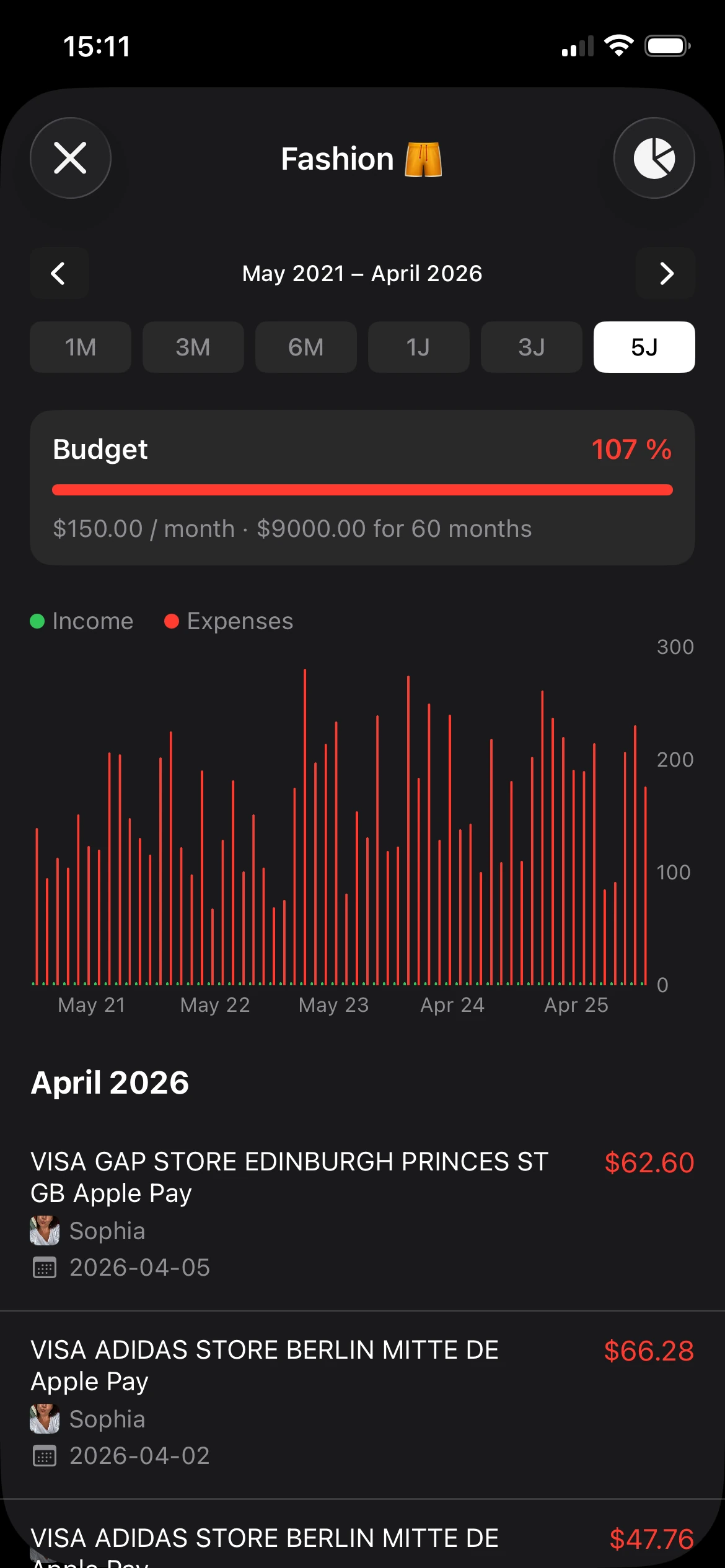
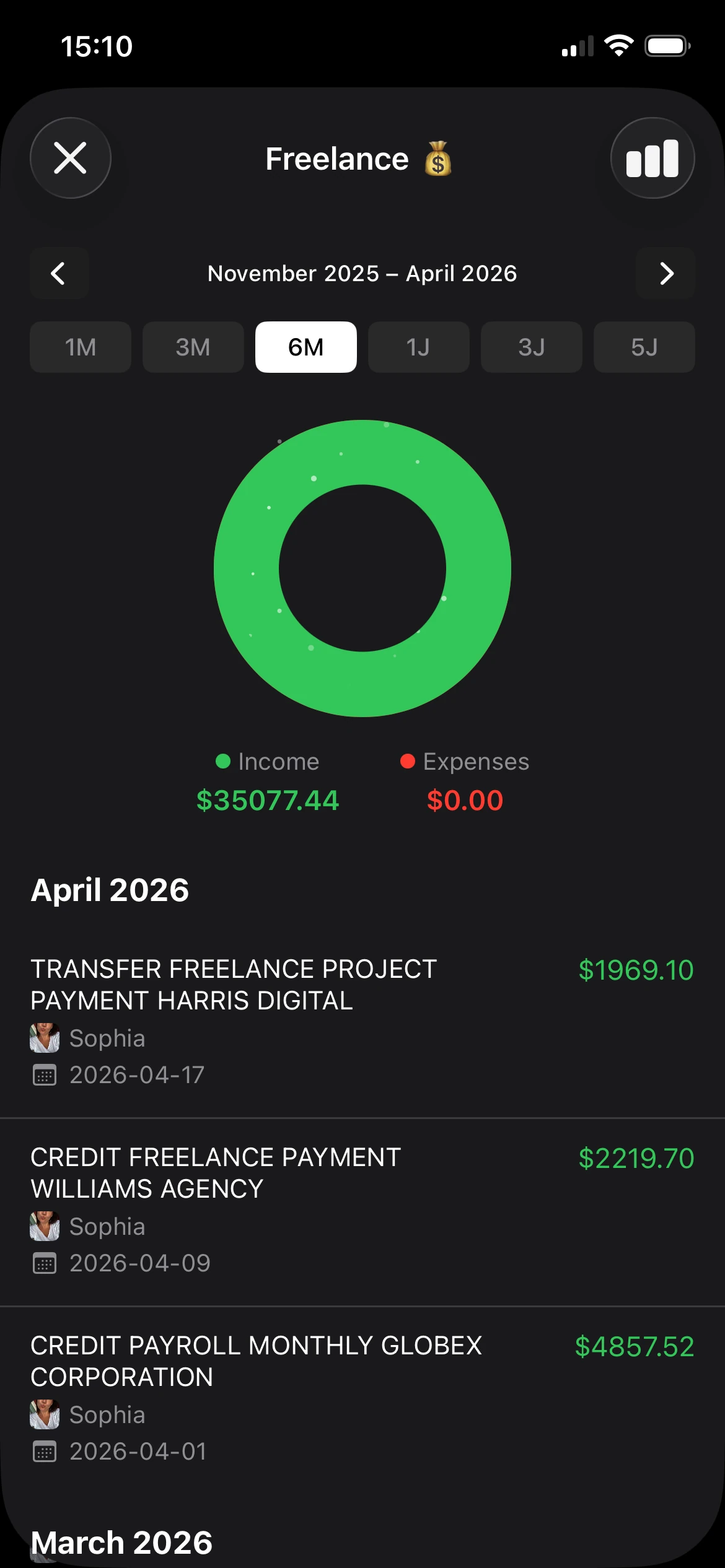
A common couple-money problem looks like this: one partner wants a simple shared record for rent, groceries, and trips, while the other does not want to connect bank accounts, create another login, or expose every personal purchase. rondre fits that middle ground.
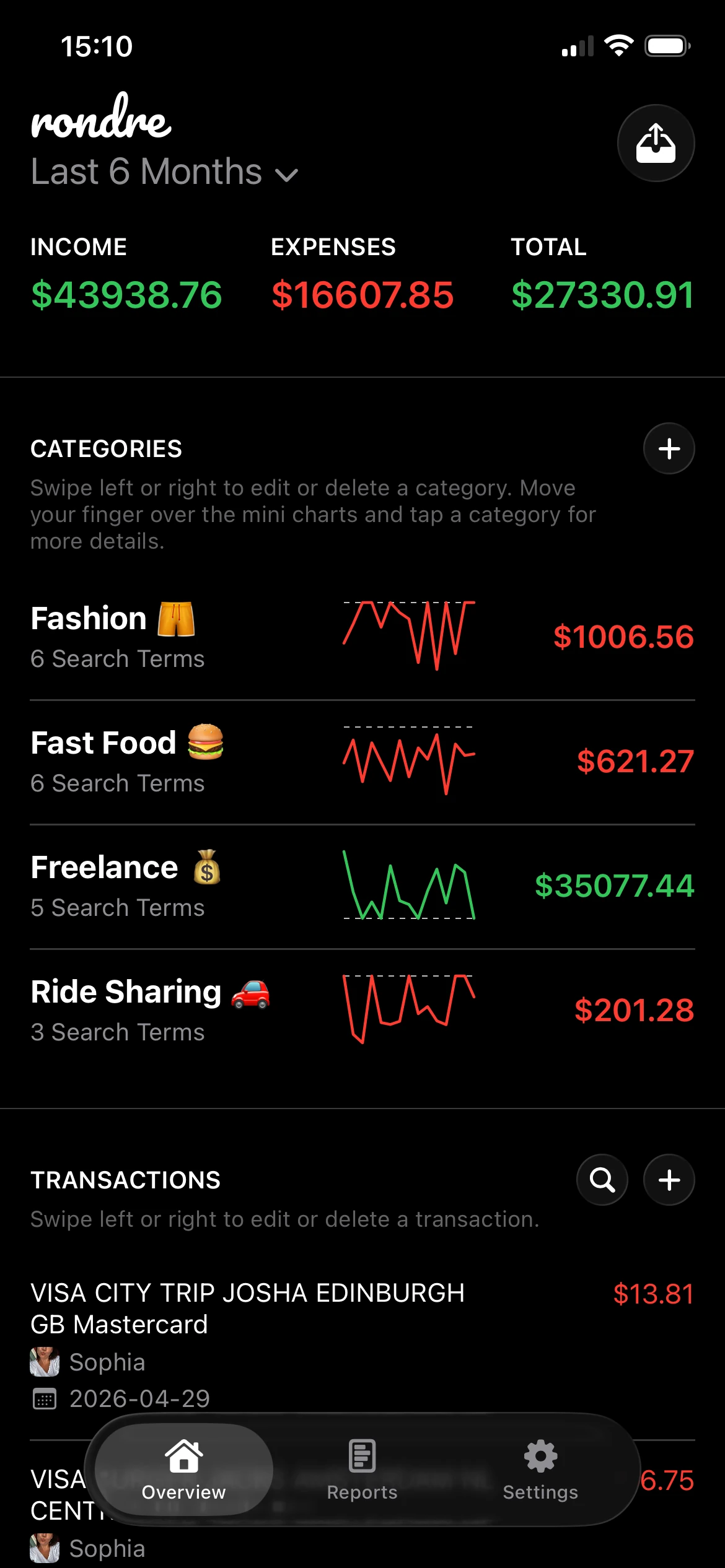
It is a budgeting app for iPhone with a lighter approach than full finance dashboards. There is no signup required to get started, and the core experience stays focused on recording spending, organizing it clearly, and sharing only the books that make sense to share. For couples deciding how to combine finances after marriage without losing all flexibility, that structure is useful.
The relationship fit matters more than the feature list here. rondre works well for couples who do not manage money in one fully merged pool. You can keep a household book for recurring shared costs, a travel book for one-off plans, and separate books for personal spending. That gives both people visibility where they need it, without forcing full financial transparency everywhere.
Privacy is a real part of the appeal. The app does not start with ads, tracking prompts, or a long onboarding flow. That lowers resistance for the partner who usually checks out the second a budgeting app starts asking for accounts, permissions, and bank connections.
The trade-off is straightforward. Couples who want automatic transaction syncing may find it too manual. rondre is better for pairs who prefer manual entry or statement imports because they want cleaner boundaries, more privacy, or fewer syncing errors. CSV and PDF bank statement import help when you want a shared record without turning the app into a live feed of every account.
A few strengths stand out in daily use:
- Good fit for split-and-share couples: Shared books make it easy to track joint expenses while leaving personal spending separate.
- Low setup friction: You can try it quickly without committing to subscriptions, account creation, or a complicated setup.
- Useful organization: Smart categories and search make it easier to find spending patterns that matter to a couple, not just to an individual.
- Less suited to automation-first households: If your ideal system pulls everything from the bank and updates itself, this will feel limited.
- Worth reviewing for storage preferences: Data lives on rondre’s servers, so couples who want local-only storage should check that against their privacy standards.
For couples who want a shared money tool that stays simple and respects boundaries, rondre is a reasonable option to consider.
2. Honeydue

Honeydue fits a common real-world money setup. One partner pays the rent, the other handles groceries and utilities, and both want a clear view of shared obligations without opening every personal account.
That relationship style is where Honeydue makes sense. It was built around couples, and it shows in the parts that matter day to day: selective sharing, bill reminders, spending alerts, and a built-in chat tied to transactions. The result is a tool that supports coordination more than strict budgeting discipline.
Best for partially merged finances
Honeydue is a strong option for couples who share responsibility but not every dollar. If the goal is “show me what affects us both, leave the rest alone,” this app handles that better than many standard budgeting tools with an added partner login.
Privacy is part of the appeal. Some couples are combining finances slowly. Others have fully separate personal spending by choice. Honeydue gives those pairs a middle ground, which is more useful in practice than an all-or-nothing setup.
The transaction chat is more helpful than it sounds. Keeping a quick note or question attached to a purchase cuts down on the usual back-and-forth. It is a small feature, but for couples trying to avoid money arguments caused by missing context, small features matter.
Honeydue works best as an awareness tool. It helps couples stay current on bills, recent spending, and shared account activity without asking them to adopt a heavy budgeting system.
The trade-off is planning depth. Couples who want detailed reporting, long-term goal mapping, or a more structured method will likely outgrow it. Account syncing can also decide the experience. When connections stay stable, Honeydue feels light and practical. When they do not, the app loses some of its appeal fast.
3. Zeta
Zeta makes the most sense for couples who want their budgeting tool and joint banking experience to live in the same place. That’s different from most apps on this list. Instead of starting with expense tracking and adding collaboration later, Zeta leans into the reality that many couples want a shared operating account for bills, sinking funds, and household goals.
The envelope-style buckets are one of its better ideas. They give couples a simple way to assign money for known priorities without needing a strict zero-based workflow. For newly married couples or partners moving in together, that can feel easier and more intuitive than a full budgeting system.
Strong fit for merge-everything couples
Zeta is best for pairs who are comfortable building a true shared money hub. Joint and family accounts, bill planning, notes, and collaboration features all support that style. Real-time notifications help both partners stay aware of what’s happening, which reduces the “I thought you saw that charge” problem.
There’s also a practical emotional advantage here. When both partners are using one system for shared cash management, fewer money tasks fall exclusively onto one person. The app’s visibility and permission controls help, especially when a couple wants shared access without making every account equally visible to everyone.
A few trade-offs are worth noting:
- Best for joint households: Couples who want one shared financial home will likely appreciate the integrated approach.
- Less ideal for hands-off support needs: Customer support is mainly in-app chat and email.
- Still maturing in permissions: Couples with more complex privacy boundaries may want more granular control than the product currently emphasizes.
Zeta isn’t the best budgeting app for couples who want light tracking only. It’s better for couples who are ready to organize shared money more deliberately.
4. Monarch Money

Monarch Money fits the couple who shares a household plan but still wants some personal space. One partner may want full visibility into bills, savings, and goals, while the other prefers to keep a few accounts private. Monarch handles that middle ground better than many apps in this category.
That balance is the main appeal. The app brings budgeting, cash flow tracking, goals, and net worth into one place, so couples can look beyond this month’s spending and make decisions at the household level. It works well for pairs managing more than groceries and rent. Think mortgages, investments, sinking funds, travel savings, and uneven income.
Best for couples with shared goals and separate boundaries
Monarch is a strong match for hybrid couples. These are the pairs who are combining parts of their financial life without turning everything into one fully shared system. In practice, that often means shared planning with selective privacy, which can lower tension for couples who have different comfort levels around money visibility.
I’ve found that setup matters more than feature count. If one partner feels watched, they stop opening the app. If the other feels shut out, the budget turns into guesswork. Monarch gives couples a cleaner way to agree on what is shared, what stays personal, and what both people need to see to run the household well.
The account syncing is also useful here. Bank accounts, credit cards, loans, and investments can sit in one dashboard, which helps couples stop managing money in pieces across four different apps.
Practical advantage: A clear dashboard sounds like a small thing, but it often decides whether both partners actually use the app after the first month.
The trade-off is cost. Monarch is a paid app, so it makes the most sense for couples who want ongoing planning and reporting, not just a simple way to split dinner or track a few monthly bills. For established couples, higher earners, or anyone trying to coordinate shared life goals without giving up all privacy, Monarch is one of the better fits in this list.
5. YNAB You Need A Budget with YNAB Together

YNAB fits couples who sit down before payday, decide what each dollar needs to do, and want a budgeting system that keeps both people accountable. YNAB Together matters because it gives partners shared access under one subscription, so the budget can stay in one place instead of living in one person’s head.
This app supports a specific relationship style. It works best for couples who are comfortable treating money as a joint planning exercise, even if some accounts stay separate. If you are a merge-everything couple, YNAB gives you a clear structure. If you are more hybrid, it can still work, but only if both partners agree on shared categories and how much visibility feels fair.
Best for couples who want a shared budgeting system
YNAB is less about passive tracking and more about active decision-making. That is the appeal. It forces regular check-ins, clearer trade-offs, and fewer vague assumptions about what is "probably fine" to spend.
I’ve seen this matter most in couples who keep having the same money argument in different forms. One person thinks there is room for extras. The other is worried about bills, debt, or upcoming irregular costs. YNAB reduces that friction by putting those choices into categories ahead of time.
Privacy is the trade-off. YNAB is strong on shared planning, but it is not the best fit for couples who want very light collaboration or a lot of financial separation. If one partner wants full visibility and the other wants more personal space, the setup conversation can get uncomfortable fast.
Where couples struggle with it
The learning curve is real. Zero-based budgeting sounds simple, but in practice it asks couples to build new habits, review the budget often, and use the same language around spending.
- Strong fit for planners: Couples who already do weekly or biweekly money check-ins usually get more value from YNAB.
- Good for uneven expenses: It handles true expenses, sinking funds, and long-term categories well.
- Tougher for low-maintenance pairs: If one partner wants budgeting to stay in the background, YNAB can feel like homework.
Cost is another factor, as noted earlier in the article. YNAB makes more sense when a couple wants an ongoing system they will use, not just a simple bill-splitting tool.
YNAB is rarely the simplest app on this list. For couples willing to commit to a shared process, it is often one of the most effective.
6. Quicken Simplifi
Quicken Simplifi fits couples who want a shared money view without turning budgeting into a weekly project. It centers on account aggregation, upcoming bills, spending tracking, and cash flow projections. For a lot of couples, that is enough.
I recommend it most often to pairs in the middle. They are not fully "merge everything" households, but they also do not want to keep texting each other, "Did that bill clear yet?" or "Can we book this trip now?" Simplifi gives both partners a current picture of what is coming in, what is scheduled to go out, and how much room is left.
Its strongest use case is practical, not ideological. One partner may care most about avoiding overdrafts and bill surprises. The other may just want a clean dashboard without learning envelope budgeting or assigning every dollar a job. Simplifi handles that balance well.
Best for couples who want visibility with less friction
Recurring transactions and projected balances are the reason many couples stick with it. If your arguments tend to start after a subscription renews, a credit card payment posts, or a large utility bill hits, Simplifi can reduce those surprises. It keeps the conversation anchored to timing and cash flow instead of guesswork.
Privacy is part of the trade-off. Simplifi works better for couples who are comfortable sharing the broad picture than for couples who want highly customized boundaries inside one app. It is useful for "mostly shared" setups. It is less suited for pairs who want detailed rules around what each partner can or cannot see.
Cost is also fairly reasonable, as noted earlier in the article. The value makes more sense for couples who want connected accounts, reminders, and a forward-looking view of bills, not just a simple split calculator.
What it does not do as well is just as important. Couples who want stronger couples-specific workflows, more intentional planning rituals, or a more hands-on method may find it a little plain. That is not a flaw for every relationship. Some couples budget better when the app stays out of the way.
7. Goodbudget

Goodbudget is the app for couples who still believe manual budgeting creates better awareness. That won’t appeal to everyone, but for some households, it’s the whole advantage. Instead of auto-importing every decision into the app and hoping the categories make sense, both partners actively maintain the plan together.
The envelope method is the core idea. Shared envelopes sync across devices, which gives couples a common spending structure without requiring a fully merged financial setup. That can feel refreshingly straightforward.
Good for privacy and spending discipline
Goodbudget is a strong fit for couples who want tighter control over discretionary spending. Groceries, dining out, gifts, travel, and home costs can each get their own envelope, and both partners can see what’s left before spending.
That shared visibility can lower tension because the app answers the usual questions upfront. Is there room in the restaurant budget? Did the household envelope already get stretched this week? The method isn’t flashy, but it’s easy to explain and easy to revisit together.
A few trade-offs stand out:
- Best for manual planners: Couples who don’t mind entering transactions tend to get more value from it.
- Good for limited bank sharing: It works even when a couple would rather avoid linking accounts.
- Less ideal for analytics lovers: The reporting is more basic than what premium apps offer.
Goodbudget isn’t the best budgeting app for couples who want passive automation. It is one of the better choices for couples who want a shared plan they can both understand at a glance.
8. Splitwise

Splitwise is not a full budgeting app, and that’s exactly why it belongs on this list. Some couples don’t need a shared budget platform. They need a clear answer to one recurring problem. Who paid, who owes, and has it been settled yet?
For dating couples, roommates who became partners, or long-term pairs who still keep mostly separate finances, Splitwise can be the cleanest solution. It removes the need to remember every dinner, utility payment, ride share, grocery run, or vacation charge.
Best for split-everything couples
Splitwise is strongest when the relationship has a reimbursement rhythm. Shared costs can be divided equally, by percentage, or by item. That flexibility matters when one partner covers rent and the other handles food, or when incomes are uneven and the split isn’t perfectly half and half.
This kind of app also lowers emotional noise. Instead of arguing about whether one person is carrying too much of the load, the ledger stays visible. That doesn’t replace broader budgeting, but it often solves the most irritating part of shared spending.
“Not every couple needs a shared budget first. Some need a fair split system first.”
The trade-off is obvious. Splitwise won’t help much with long-term planning, savings goals, or household cash flow. Many couples pair it with another tracker for that reason. But when the problem is reimbursement friction, few tools are simpler.
9. Spendee

Spendee works best for couples who want shared visibility without stepping into a strict budgeting framework. Its Shared Wallets feature gives partners a common place to add and categorize transactions, which makes it useful for joint household spending, travel budgets, or family costs.
The visual design is a big part of the appeal. Some apps are functionally strong but hard to read quickly. Spendee leans the other way. Spending breakdowns are colorful and immediate, which can help both partners engage with the numbers instead of ignoring them.
A good middle ground for lighter planners
Spendee suits couples who want to track trends more than enforce a rigid system. If the household mostly needs to know where money is going and whether shared spending is drifting up, it does that well. The app can feel less intimidating than more method-heavy tools.
Its regional connection options may also appeal to couples who use a mix of bank and e-wallet services, although availability varies. That matters for households with nontraditional payment habits or cross-border spending.
The catch is that Shared Wallets require a paid tier, and pricing is shown in-app and can vary by platform or region. That makes it harder to compare on price alone. Still, for couples who care about readability and fast collaboration, Spendee is a solid option.
10. HomeBudget with Sync
HomeBudget with Sync is the old-school choice on this list. It doesn’t pretend to be the sleekest app, and that’s fine. Its value is in manual control, offline-friendly use, and family syncing across devices.
Some couples prefer that older style because it feels stable and contained. There’s less pressure to connect every account, less dependence on cloud-style automation, and more control over what gets entered. For privacy-minded households, that simplicity can be reassuring.
Best for manual trackers who want ownership
HomeBudget with Sync is a practical fit for couples who already know they don’t want bank aggregation. Income, expenses, bills, transfers, charts, CSV export, and local backups cover the core tasks. Family Sync keeps both partners on the same data without requiring the kind of ecosystem buy-in that premium apps often expect.
It also fits couples who prefer a one-time purchase model for the core app rather than another monthly subscription. That won’t matter to everyone, but it matters a lot to households tired of stacking recurring software costs.
A few limits are hard to ignore:
- Best for offline-friendly use: It works well for couples who don’t need constant connected account updates.
- Strong for private manual budgeting: Local backups and manual entry appeal to households that want more control.
- Less polished than newer apps: The interface feels older, and that can affect day-to-day use.
HomeBudget with Sync isn’t trying to be modern and fully automated. It’s trying to be dependable. For the right couple, that’s enough.
Top 10 Couples Budgeting Apps Comparison
| Product | Key features | Collaboration / Sharing | Privacy & Setup | Best for | Price |
|---|---|---|---|---|---|
| rondre | Quick manual entry + CSV/PDF import, smart categories, mini/bar/donut charts | Shared books for partners/families; multiple books for projects | No signup (no email/password), no ads or tracking; server-stored data | Individuals, couples, families, freelancers who want fast, private tracking | 100% free (no paywalls; donations optional) |
| Honeydue | Linked accounts, bill reminders, transaction chat | Shared view of accounts; in-app messaging tied to transactions | Requires account and bank links; standard app permissions | Couples wanting synced accounts + built-in communication | Free |
| Zeta | Joint/family accounts, envelopes, bill planning | Real joint accounts with permission controls and shared tools | Signup required; banking via partner (FDIC) | Couples/families wanting combined banking + budgeting | Free / bank terms apply |
| Monarch Money | Bank & investment aggregation, cash-flow, goals, net worth | Partner invites with household/personal views | Account signup; bank connections; polished UX | Couples wanting robust reporting and planning | Paid subscription |
| YNAB (with Together) | Zero-based budgeting, category rules, education | YNAB Together: shared subscription, separate logins | Account required; methodology-focused workflows | Couples wanting method-first, hands-on budgeting | Paid subscription |
| Quicken Simplifi | Spending watchlists, bill tracking, cash-flow projection | Share via single login or household subscription | Account & bank links; web + mobile access | Day-to-day budgeters tracking bills and cash flow | Paid subscription (often discounted) |
| Goodbudget | Envelope-style budgeting, reports, debt tools | Shared envelopes synced across devices | Optional signup; works offline without bank sync (Premium adds sync) | Couples preferring manual envelopes and privacy | Free; Premium optional |
| Splitwise | Split tracking, settle-up payments, simple IOUs | Focused on expense splitting with group balances | Account required; minimal budgeting features | Partners who keep separate finances and only split costs | Free; Pro tier paid |
| Spendee | Shared Wallets, colorful visuals, bank/e-wallet connects | Shared Wallets for couples/families (adds transactions collaboratively) | Account + bank links; visual-first UI | Couples wanting attractive shared spending views | Freemium (Shared Wallets require paid tier) |
| HomeBudget with Sync | Offline budgeting, bills, CSV export, local backups | Family Sync across devices (no bank aggregation) | One-time purchase; local backups; offline-friendly | Couples wanting private, manual tracking & one-time buy | One-time purchase (no recurring fee) |
Final Thoughts
A couple downloads a budgeting app after one tense conversation about money. Two weeks later, the app is not the issue. One partner wants full visibility. The other wants a little personal space. That mismatch is what usually decides whether a tool sticks.
The best budgeting app for couples fits the money dynamic that already exists. Couples who combine everything need shared visibility and fewer handoffs. Couples who split expenses need clear balances and low-friction settling up. Hybrid couples usually need both shared coordination and some privacy, which is where a lot of apps fall short.
rondre makes sense for couples who want a simple place to start without adding account setup, subscription pressure, or more financial exposure than they want. It works well for testing a shared category, keeping personal and household tracking separate, or building a routine before deciding whether bank sync and deeper automation are worth the trade-off.
Honeydue and Zeta are built more directly around couple use. Honeydue fits pairs who want selective sharing and lightweight coordination without combining every detail. Zeta is a better fit for partners who are closer to running one household system. Monarch Money suits couples willing to pay for broader household visibility, especially if net worth and long-term planning matter as much as monthly spending. YNAB works best for couples who want a strong budgeting method and are willing to stay actively involved.
The rest of the list fills specific roles. Quicken Simplifi is useful for bill tracking and cash-flow planning. Goodbudget suits couples who prefer manual envelope budgeting and less bank connection. Splitwise solves a narrower problem, but it solves it well for partners who mostly need fair expense splitting. Spendee appeals to couples who want a more visual shared view. HomeBudget with Sync is a solid fit for manual trackers who care more about control and privacy than automation.
Privacy deserves more attention than it usually gets in roundups like this. Shared access helps, but full transparency is not the right setup for every couple. In practice, the best app is often the one that lets both people participate without making either person feel watched, exposed, or boxed into a system they did not choose.
Start smaller than you think. Pick one category, groceries, rent, travel, or dining out, and track it together for a month. That test will show whether the app supports your relationship style, how much detail you both want, and whether the system feels easy enough to keep using.